
AI vs Junior developer
― How AI is changing junior developers’ careers ―
In this article, we spoke with our engineer who started their career in the age of AI about how rapid advances in AI are transforming the careers of young engineers.
– First of all, tell us who you are and how you joined MUSE.
Sure, my name is Daniele, I am 24 years old, Italian, and I work as a robot software engineer at MUSE. In October 2024, I graduated in Computer Science from the University of Milan. Afterward, I wanted to try an experience abroad, and that is where I came across MUSE, which offered me a 3-month internship during the spring of 2025.
During my internship, I was tasked with evaluating the feasibility of introducing a low-power mode for the robot and, if viable, providing an implementation. By the end of the internship, I was able to deliver a working demo in which the robot's battery life increased by approximately 25% during active operation and by approximately 45% when the robot was in an IDLE state. Throughout this experience, I gained a broad understanding of robotics, from managing key subsystems (localization, control, cloud communication, etc.) to using various tools for debugging and troubleshooting.
Once the internship was completed, I was offered to join the team, and so I decided to move to Tokyo to start my career at MUSE, ready to improve my skills and acquire as much knowledge as possible in the field of robotics.

How is starting a career in AI era?
– Your academic journey can be divided into two phases by the advent of AI: the pre-AI era and the post-AI era. Tell us a bit about this event that has marked everyone, professionals and students, in this field, and what it means to start your working career in a path like this.
I think I was lucky to be part of the group of people who lived a part of their IT career in the "pre-AI" era. I consider it a precious aspect, a point of view destined to disappear over time and which the new generations of developers will not have access to.
Several years ago, when I was still a high school student, I imagined a completely different way of working; I would never have imagined that I would use a tool of this kind and with this power. Currently, I use AI daily; I am learning to leverage it to make my work more efficient and of higher quality, but not only that, I think it is a fundamental tool to improve and learn much faster than before.
Obviously, it remains essential to verify the notions learned using AI by going to read and study the scientific literature, but it is undeniable that the learning curve is faster.
Will a junior developer be replaced by AI?
– How is AI perceived within MUSE, and how does the company integrate it into your daily work?
Regarding the work aspect, initially I was worried that the advent of AI could make finding a job difficult, especially because AI improves exponentially day by day. Suffice it to consider that for many years Moore's Law (the doubling of transistors in chips every two years) was the undisputed symbol of technological progress. Today, the computing power used to train AI models doubles approximately every six months, a pace four times faster.
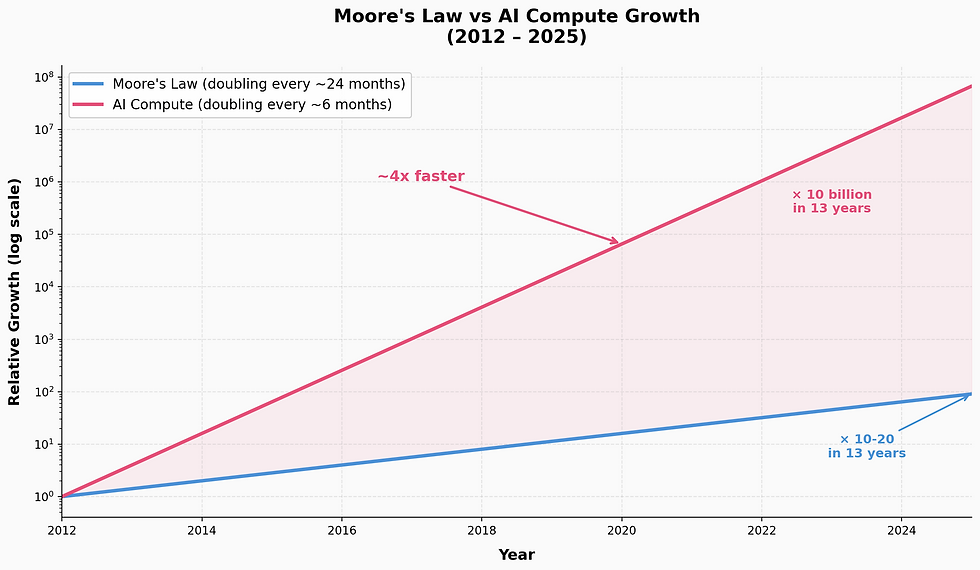
I remain convinced that in a short time, AI will acquire such a capability as to be able to completely replace junior developers (but also developers with several years of experience), but I am of the idea that human supervision remains fundamental. Therefore, I think that AI, instead of "stealing" our jobs, will simply make them different, as has already happened in the past with many professions.
Is this hot topic treated differently based on country?
– You work in Japan but you're from Italy. Do you notice any differences in how AI is perceived and adopted across different countries?
I think the situation is general and not dependent on the country you are in. Speaking with a peer of mine who works in the IT sector in Italy, we noticed how there are no substantial differences both in the use of AI and in the effect it is having on the sector. Furthermore, the internet is full of people sharing their experiences, and very often I have found myself relating to many of their thoughts and ways of leveraging AI in the workplace.
How to use AI to learn and improve your work?
– Can you walk us through how you actually use AI in your day-to-day work? Do you have a specific approach or workflow?
Personally, I leverage AI as if it were a colleague tasked with listening to my progress, my ideas, and the solutions to my problems.
Initially, given the problem to be solved, I try to formulate the best solution I can come up with, and subsequently, before starting the implementation, I show my design to the AI, providing the reasons for my choices, asking for an opinion, and asking it to ask me questions.
In this way, I can get insights to improve my solution and to understand if I can view the problem from a different point of view. Subsequently, I start discussing with the AI in order to resolve the critical issues of my solution until I have a first draft of the solution, and finally, I show this draft to my team and my superiors who have more experience than me.
I am convinced that this is the best way to acquire as much knowledge as possible, treating AI as a senior colleague, which however does not replace (but simply adds to) the more experienced colleagues.
How is AI used in MUSE?
– How does MUSE approach AI adoption? Is it used mainly to cut costs, or is there a different philosophy behind it?
At MUSE, I found an environment that actively provides the tools needed for employees to work efficiently and deliver high-quality results. AI is naturally integrated into daily development workflows as one of these tools.
In recent years, the rapid advancement of AI has influenced how companies think about development and talent, including discussions around junior hiring [1]. This topic has also been commented on by industry leaders such as AWS CEO Matt Garman [2].
Within this context, MUSE focuses on adapting to an AI-driven development style while continuing to invest in people and their growth. In particular, the company values creating an environment where engineers, including those at an early stage in their careers, can learn quickly and improve by leveraging AI alongside hands-on experience.
Rather than viewing AI purely as a cost-reduction tool, MUSE approaches it as a way to augment engineers’ capabilities and support the advancement of robotics. I am very happy to be part of an environment that uses AI to help engineers grow and contribute to the field.
References
1: https://digitaleconomy.stanford.edu/publication/canaries-in-the-coal-mine-six-facts-about-the-recent-employment-effects-of-artificial-intelligence/
Join Us
We’re growing our team. MUSE is currently hiring for a variety of positions across engineering, business, and corporate fields.
If our vision excites you, and you’re interested in the challenge of creating the future from scratch, we’d love to hear from you. Casual meetings and office tours are always welcome!
For job posting and application:
Looking forward to talking to you!


